Seminar and Workshop: DigiArcheoSpace - Modern Tools for Documenting and Presenting Cultural Heritage
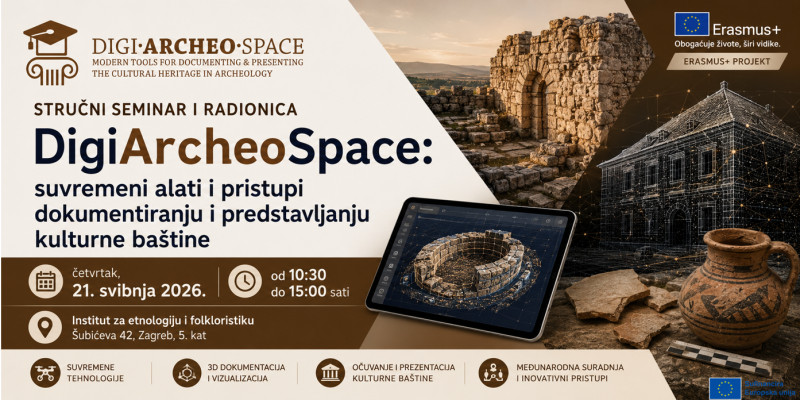
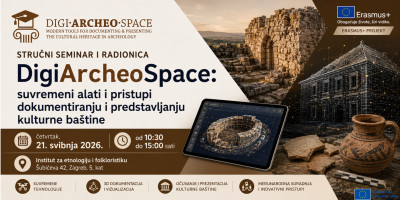
The seminar and workshop “DigiArcheoSpace: Contemporary Tools and Approaches to Documenting and Presenting Cultural Heritage” will take place on Thursday, May 21, 2026, from 10:30 AM to 3:00 PM at the Institute of Ethnology and Folklore Research, Šubićeva 42, Zagreb, 5th floor.
The event is organized within the framework of the Erasmus+ project DigiArcheoSpace – Modern Tools for Documenting and Presenting Cultural Heritage in Archaeology, dedicated to the development of contemporary digital tools, educational materials, and methods for the documentation, preservation, interpretation, and presentation of cultural heritage, with a particular focus on archaeology and digital research practices.
The seminar and workshop are intended for researchers, teachers, students, and professionals in the fields of archaeology, ethnology, cultural anthropology, art history, museology, archival studies, library science, cultural heritage, and digital humanities, as well as for anyone engaged in the digital documentation and presentation of heritage content in their research, educational, or professional work.
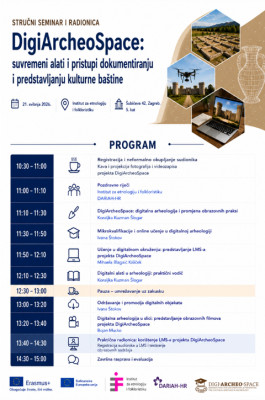
The programme will include presentations of the objectives and results of the DigiArcheoSpace project, educational materials and micro-credentials, the project’s LMS platform, a practical guide to contemporary digital tools in archaeology, and educational films produced within the project. The final part of the event will be dedicated to a practical workshop, participant registration on the LMS platform, and testing of educational content.
Participation is free of charge; however, due to the limited number of places, prior registration via this form is required.
The event is implemented with the financial support of the European Union within the Erasmus+ programme. The views and opinions expressed are those of the authors and organizers and do not necessarily reflect the views of the European Union or the European Education and Culture Executive Agency (EACEA).